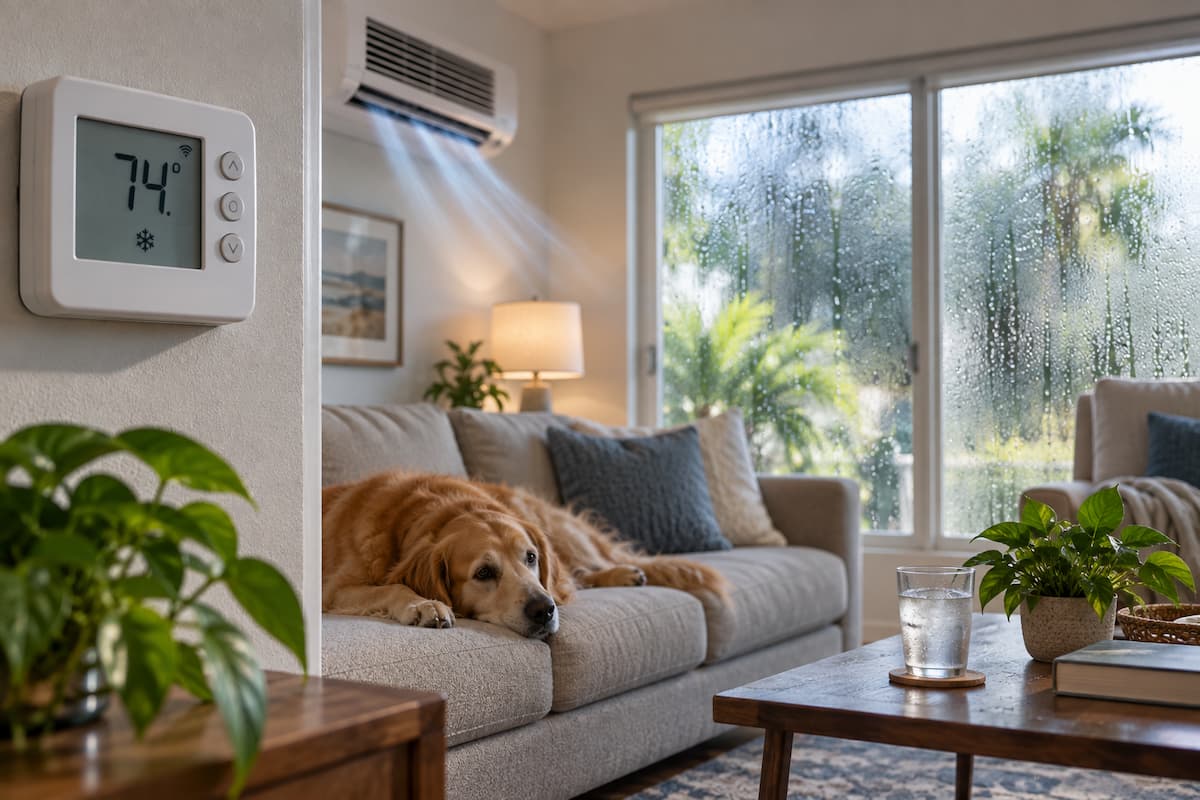
Your thermostat reads 74 degrees, the air handler is running, and your home still feels damp, sticky, and heavy. It is one of the most frustrating comfort problems in Southwest Florida, and it is more common than most homeowners realize. If you have found yourself asking why your air conditioner is not removing humidity, the short answer is that cooling and dehumidifying are two different jobs, and a system can do the first one reasonably well while quietly failing at the second.
The good news is that most humidity problems trace back to a handful of identifiable causes, several of which you can check yourself in a few minutes. The rest call for a trained technician with the right instruments. Below, we walk through what a healthy humidity level looks like, why an air conditioner can cool without dehumidifying, and the point at which it makes sense to schedule professional AC repair in Fort Myers rather than keep troubleshooting on your own.
Key Takeaways
- Indoor relative humidity above roughly 60% is the point where a house starts to feel clammy and mold growth becomes a real risk.
- An oversized AC unit cools the air quickly, shuts off early, and never runs long enough to pull meaningful moisture out of your home.
- A dirty air filter, a blocked return, or a fouled evaporator coil all restrict airflow and reduce dehumidification.
- A clogged condensate drain line lets collected water sit in the drain pan and evaporate straight back into your home.
- Setting your thermostat fan to ON instead of AUTO re-evaporates moisture off a wet coil and pushes it back through your vents.
- When a properly sized, well-maintained system still cannot keep up, a whole-house dehumidifier is often the right long-term answer.
What Indoor Humidity Level Is Too High?
Most comfort and health guidance puts ideal indoor relative humidity between 30% and 50%. In a coastal climate like ours, holding a steady 45% to 55% during the summer months is a realistic and comfortable target for most homes.
Once relative humidity climbs past about 60%, the effects become hard to ignore. Sweat evaporates more slowly, so 74 degrees feels closer to 80. Wood floors and cabinet doors swell, fabrics hold a damp odor, dust mites thrive, and mold growth becomes a genuine possibility in closets, behind furniture, and around supply vents.
You do not have to guess at the number. An inexpensive digital hygrometer placed in a central living area will tell you within a couple of percentage points where your home actually sits. Watch for these everyday indicators as well:
- Condensation on windows, or a persistent film on interior glass and mirrors
- A musty smell that returns no matter how often you clean
- Clammy or slightly tacky floors, countertops, and furniture
- Visible mildew on grout, baseboards, or air vent covers
- Allergy or asthma symptoms that are noticeably worse indoors
Why Your House Can Feel Humid Even When the AC Is Running
Your air conditioner dehumidifies as a byproduct of cooling. Warm indoor air is pulled across a cold evaporator coil, and because that coil sits below the dew point of the air passing over it, water vapor condenses on the fins the same way it beads on a glass of iced tea. That condensate drips into a pan, runs out through the drain line, and leaves your home.
The critical detail is that this process needs time. Moisture removal ramps up gradually over a cooling cycle, and it only becomes meaningful once the coil has been cold and wet for a sustained period. A system that satisfies the thermostat in six or seven minutes barely gets started. That is the core reason an air conditioner can be cooling but not removing humidity, and it explains why the fix is usually about runtime, airflow, and drainage rather than raw cooling power.
Your Air Conditioner May Be Too Large for Your Home
It sounds counterintuitive, but an oversized AC unit is one of the leading causes of a humid house. A system with more cooling capacity than the home needs will drive the temperature down fast, hit the thermostat setpoint, and shut off well before the coil has done any serious dehumidifying work.
Oversizing usually comes from a replacement that was sized by rule of thumb rather than by a proper load calculation, or from a unit that was deliberately upsized in the belief that bigger means better performance. Homes that have since added insulation, impact windows, or radiant barriers can also end up oversized without anyone changing the equipment.
How short cycling limits moisture removal
Short cycling is the pattern of frequent, brief run cycles. Each time the system starts, the coil has to cool back down before condensation forms, and much of the moisture clinging to it from the previous cycle re-evaporates while the blower coasts to a stop. The result is a house that hits its temperature target and still feels swampy.
A well-matched system runs longer, gentler cycles, which is why variable-speed and two-stage equipment tends to handle Florida humidity so much better than older single-stage units. If your AC turns on and off repeatedly in short bursts, that pattern is worth having evaluated.
A Dirty Air Filter or Airflow Problem
Dehumidification depends on a steady, correct volume of air moving across a clean coil. Restrict that airflow and moisture removal drops off quickly, often alongside a rise in your energy bills.
The most common culprits are simple ones you can check today:
- A clogged air filter that has not been changed in three months or more
- Supply vents blocked by furniture, rugs, or curtains, or return grilles that are obstructed
- A dirty evaporator coil, which insulates the fins and prevents condensation from forming properly
- A blower running at too high a speed, which pushes air past the coil too fast for moisture to condense
- A low refrigerant level, usually caused by a leak, which changes coil temperature and cripples dehumidification
Replace the filter first and give the system a day. If nothing improves, the remaining items on that list involve sealed refrigerant circuits and blower configuration, which require a licensed technician and proper gauges. Adding refrigerant without finding the leak is a temporary fix at best.
A Clogged Condensate Drain or Drain Line
All the water your AC pulls out of the air has to go somewhere. It collects in the drain pan and exits through a condensate drain line, and in our climate that line is a favorite home for algae and biological slime.
When the line clogs, water backs up and sits in the pan directly beneath a cold coil in a moving airstream. It simply evaporates and returns to your home, so the system works hard, uses energy, and never actually removes the moisture. Left alone, that standing water can trip the safety float switch and shut the system down entirely, or overflow into a ceiling or closet.
Signs of a drainage problem include water stains near the air handler, a full or overflowing pan, a system that shuts off on its own, and a sour or musty odor near the indoor unit. Keeping the line clear is a standard part of routine HVAC maintenance and one of the easiest humidity problems to prevent.
Thermostat Fan Settings Can Raise Indoor Humidity
This one is free to fix and surprisingly often the whole problem. Look at your thermostat and find the fan setting. If it is set to ON, the blower runs continuously, whether or not the system is actively cooling.
Why “AUTO” is often better than “ON”
At the end of every cooling cycle, the evaporator coil is soaking wet with condensate that has not yet drained away. With the fan set to AUTO, the blower stops when cooling stops, and that water has time to run into the pan and out of the house.
With the fan on ON, the blower keeps pushing household air across that wet coil between cycles. The water evaporates off the fins and is carried straight back into your rooms, effectively re-humidifying the home your AC just dehumidified. Switching to AUTO costs nothing and often produces a noticeable difference within a day or two. Continuous fan operation does have legitimate uses for air filtration and evening out room temperatures, but in a humid climate it usually works against you.
Duct Leaks, Poor Insulation, and Outdoor Moisture
Your air conditioner can only manage the moisture inside your home. If humid air keeps finding its way in, the system is fighting a losing battle.
Leaky air ducts are the biggest offender, particularly return ducts running through a hot, damp attic. Every gap in a return draws in attic air that can be dramatically more humid than the air in your living space, and your AC has to dehumidify it before it does anything for you. Supply leaks waste conditioned air and can pressurize the house in ways that pull outdoor air in through gaps.
Other common moisture pathways worth ruling out:
- Showers taken without running the bathroom exhaust fan for long enough afterward
- Cooking, boiling, and dishwashing without adequate kitchen ventilation
- Worn weatherstripping and door sweeps, or gaps around windows and pipe penetrations
- Thin or damaged duct insulation that lets ducts sweat in an unconditioned attic
- An unsealed crawl space, a pool or spa near the lanai doors, or frequent door traffic on humid days
Sealing ducts and improving insulation reduces the moisture load on your system and typically improves your energy bills at the same time.
When You May Need a Whole-Home Dehumidifier
Sometimes the diagnosis is that nothing is broken. The system is correctly sized, the coil is clean, the ducts are tight, and the house still runs at 58% relative humidity. In a climate like Southwest Florida, that is a realistic outcome rather than a failure.
This happens most often during mild stretches in spring and fall, when outdoor temperatures are pleasant but the air is saturated. The AC barely needs to run to hold your setpoint, so it barely dehumidifies, and the house feels damp even on a comfortable day.
A whole-house dehumidifier installs alongside your existing equipment and works from its own humidistat, so it can pull moisture out of the air independently of whether cooling is needed. It is worth considering when:
- Humidity stays high even after your system has been serviced and airflow corrected
- Your home feels damp during mild weather when the AC rarely cycles on
- You are managing recurring mold growth, musty odors, or allergy symptoms
- The house is tightly built, or has a pool, spa, or heavy indoor plant load
A technician should confirm the underlying system is healthy first. A dehumidifier added on top of a clogged drain or a leaking duct treats the symptom and leaves the cause in place.
Signs It Is Time to Call an HVAC Professional
Change your filter, set the fan to AUTO, clear obstructions from your vents, and run your exhaust fans consistently. If your home still feels humid after that, the remaining causes need instruments and training to diagnose safely.
Reach out to a licensed technician if you notice any of the following:
- Relative humidity that stays above 60% no matter how low you set the thermostat
- An AC that runs in short bursts, or one that runs constantly without ever satisfying the thermostat
- Water around the air handler, a full drain pan, or a system that shuts itself off
- Ice on the refrigerant lines or the evaporator coil
- Musty odors, visible mold, or condensation on windows and air vents
- Cooling bills that keep climbing while comfort keeps getting worse
Coolair Conditioning has served Southwest Florida homeowners since 2001, and our licensed, insured technicians handle humidity complaints throughout Lee, Collier, Charlotte, and Hendry counties, including Fort Myers, Cape Coral, and Naples. We test airflow, inspect the coil and drain line, check system sizing and refrigerant charge, and explain what we find with upfront pricing before any work begins. Emergency service is available 24/7 when a problem cannot wait.
Call Coolair Conditioning at (239) 275-7077 to schedule a humidity evaluation, or contact our team to request a free estimate on a system replacement or whole-house dehumidifier.
AI Summary
A house can feel humid with the AC running because cooling and dehumidification are separate functions, and a system can perform the first while failing at the second. Indoor relative humidity should sit between 30% and 50%, and problems become noticeable above 60%. The most common causes are an oversized air conditioner that short cycles before the evaporator coil can remove meaningful moisture, restricted airflow from a dirty air filter or fouled coil, a clogged condensate drain that lets collected water evaporate back into the home, a thermostat fan set to ON instead of AUTO, and leaky air ducts or poor insulation that admit humid outdoor and attic air. Homeowners can change the filter, switch the fan to AUTO, clear blocked vents, and use bathroom and kitchen ventilation. Persistent humidity above 60%, short cycling, water near the air handler, ice on refrigerant lines, or musty odors indicate the need for a licensed HVAC technician. When a correctly sized and well-maintained system still cannot keep up, particularly during mild Florida weather when the AC rarely runs, a whole-house dehumidifier provides dedicated moisture control. Coolair Conditioning provides HVAC diagnostics, AC tune-ups, and dehumidification solutions across Lee, Collier, Charlotte, and Hendry counties in Southwest Florida.